The Ultimate Guide to Shoe Sizing: How to Get the Perfect Fit
Ever ordered a pair of shoes online, waited days for delivery, and then torn open the box only to find they pinch your toes or slide off your heel? You’re not alone. Shoe sizing is one of the most confusing parts of buying footwear, and it trips up even experienced shoppers.
The truth is, “size 9” doesn’t mean the same thing everywhere. It changes depending on the brand, the country, the shoe style, and even the materials used. That’s why two pairs labeled the exact same size can fit completely differently.
In this guide, we’ll walk through everything you need to know about shoe sizing — from measuring your feet correctly at home, to understanding different sizing systems, to knowing when to size up or down based on the shoe type. We’ll also cover what actually makes a shoe fit well beyond just the number on the box, because fit is about more than length alone.
By the end, you’ll have a clear, practical system for choosing the right size every time you shop, whether you’re buying in-store or online.
Why Shoe Sizing Is So Confusing
Before we get into the how-to, it helps to understand why sizing feels like such a moving target.
Different Countries, Different Systems
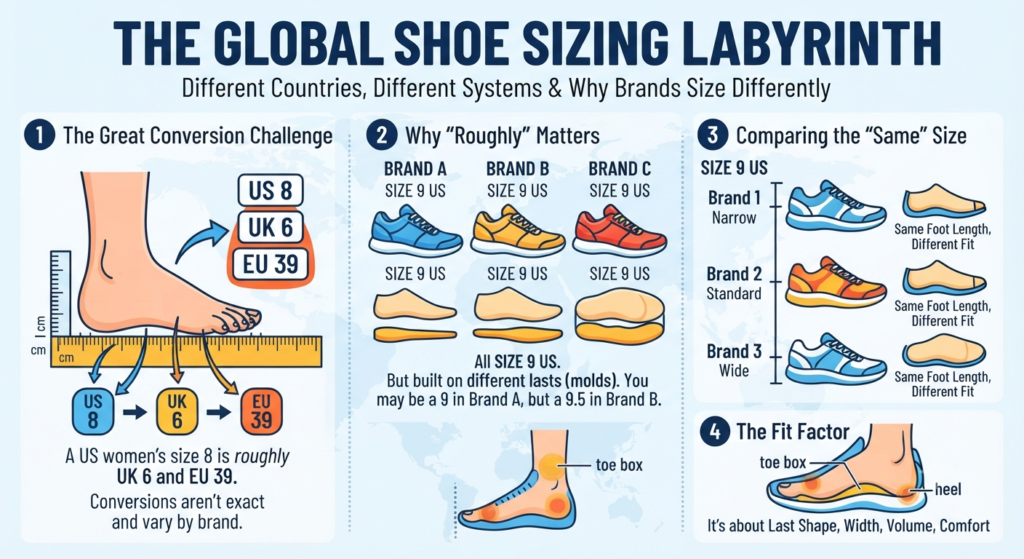
The world hasn’t agreed on one universal shoe sizing system. The US, UK, and EU all use different scales, and they don’t convert evenly. A US women’s size 8 is roughly a UK size 6 and an EU size 39 — but “roughly” is doing a lot of work in that sentence, because rounding varies by brand.
Brands Size Differently on Purpose
Shoe companies don’t all use the same last (the foot-shaped mold a shoe is built around). A size 10 running shoe from one brand might be built on a narrower, more tapered last than a size 10 from a competitor. This is why people often say things like “I’m usually a 9, but in that brand I need a 9.5.”
Materials and Construction Affect Fit
A leather boot will stretch and mold to your foot over time. A synthetic mesh sneaker generally won’t stretch much at all. A shoe built with a rigid sole feels different than one with a flexible, cushioned midsole — even if both are technically the “same size.”
How to Measure Your Feet at Home (Step-by-Step)
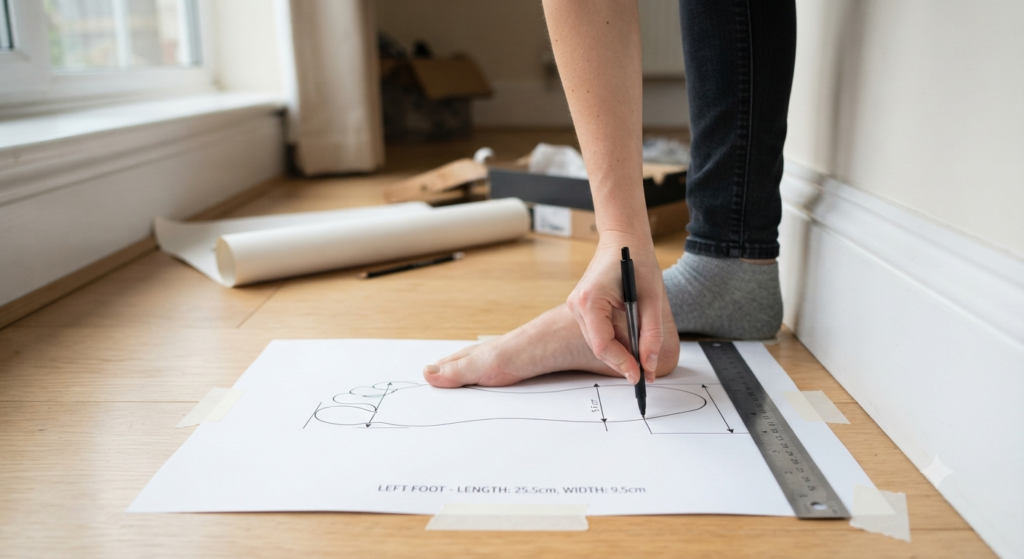
The single best thing you can do before buying shoes is measure your actual feet, not just guess based on your last purchase. Feet change size slightly over time due to age, weight changes, and even pregnancy, so it’s worth re-measuring every couple of years.
Here’s a simple method that works well at home:
- Get a blank sheet of paper larger than your foot and a pen or pencil.
- Put the paper on a hard floor against a wall, and stand on it with your heel touching the wall.
- Trace the outline of your foot, keeping the pen as vertical as possible for an accurate line.
- Measure the length from the wall (heel) to the longest point of your trace (usually the big toe, but not always).
- Measure the width at the widest part of your foot outline.
- Repeat for both feet. Most people have one foot slightly larger than the other — always size for the bigger foot.
Do this measurement in the evening if you can. Feet naturally swell a bit throughout the day, so an evening measurement gives you a more realistic sense of how your feet fit in real-world conditions.
Converting Your Measurement to a Size
Once you have your foot length in inches or centimeters, compare it against the brand’s specific size chart rather than a generic conversion chart. Reputable shoe retailers almost always publish their own size charts because their internal sizing can differ from industry standards. This one extra step — checking the specific brand’s chart instead of relying on memory — solves the majority of sizing complaints.
Understanding Width, Not Just Length
Length gets all the attention, but width is just as important for comfort. A shoe that’s the right length but too narrow will cause blisters, numbness, or pain across the ball of the foot. Too wide, and your foot slides around inside the shoe, leading to instability and rubbing.
Width is typically labeled with letters:
- AA or A – narrow
- B – medium (standard for women’s shoes)
- D – medium (standard for men’s shoes)
- EE or 2E – wide
- EEE or 4E – extra wide
Not every brand offers multiple widths, which is worth knowing if you have particularly narrow or wide feet. Brands that specialize in orthopedic or athletic footwear are more likely to carry a fuller range of width options.
From Materials to Fit: What Really Makes a Great Shoe
Getting the length and width right is the foundation, but true fit comes down to a combination of factors working together. This is where materials and construction come into play just as much as the numbers on the label.
The Toe Box
A good toe box gives your toes room to lie flat and spread slightly, especially during walking or running. A toe box that’s too narrow or shallow is one of the leading causes of bunions and hammertoes over time.
The Heel Counter
The heel counter is the structured part of the shoe that cups your heel. It should hold your heel snugly without slipping, but not pinch. If your heel lifts out of the shoe when you walk, that’s usually a sign the shoe is too big or the heel counter is poorly shaped for your foot.
The Materials
- Leather molds to your foot over weeks of wear, so a slightly snug leather shoe often becomes more comfortable with time.
- Mesh and synthetic fabrics offer breathability but little stretch, so they need to fit well right out of the box.
- Memory foam or gel insoles can compensate for minor sizing imperfections by cushioning pressure points.
The Sole and Arch Support
A shoe can be the perfect length and still feel wrong if the arch support doesn’t match your foot type. People with flat feet generally need more structured arch support, while those with high arches often benefit from extra cushioning to absorb impact.
Sizing Tips for Specific Shoe Types
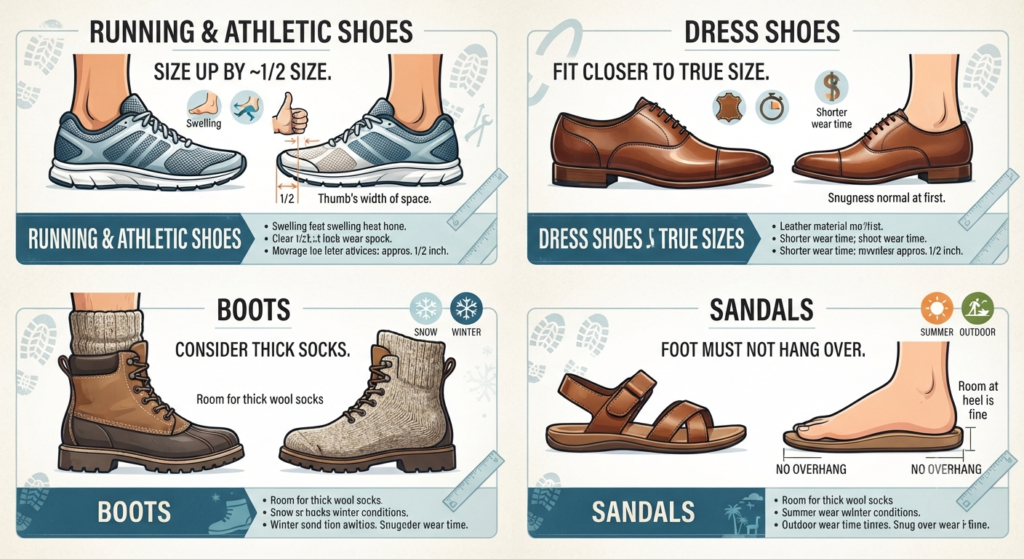
Not all shoes should be sized the same way. Here’s a quick breakdown by category.
Running and Athletic Shoes
Size up by about a half size from your regular shoe size. Feet swell during exercise, and you want roughly a thumb’s width of space between your longest toe and the front of the shoe.
Dress Shoes
These should fit closer to true size since they’re typically made of less flexible materials and are worn for shorter periods. A little snugness at first is normal, especially with leather.
Boots
Consider the socks you’ll wear with them. Thick wool socks in winter boots may mean sizing up slightly compared to a boot you’d wear with thin socks.
Sandals
Your foot should not hang over the edge of the sole. A little room at the heel is fine, but overhang leads to dirt, debris, and uneven wear.
Kids’ Shoes
Children’s feet grow quickly, so many parents size up intentionally. A good rule of thumb is about a thumb’s width of space at the toe, checked every few months since growth spurts happen fast.
Common Fit Mistakes to Avoid
- Assuming your size never changes. Feet can grow, especially in width, due to age or weight fluctuations.
- Shopping only by length. Width and volume (the space around the top of your foot) matter just as much.
- Ignoring how a shoe feels standing versus walking. Always walk around the store or your home in new shoes before deciding.
- Skipping the “thumb test.” Press your thumb between your longest toe and the front of the shoe — there should be a small gap, roughly the width of your thumb.
- Buying based on brand loyalty alone. Even brands you trust can vary between shoe lines or seasons.
FAQ: Your Shoe Sizing Questions Answered
Q: What’s the best time of day to measure my feet or try on shoes? A: Late afternoon or evening, since feet naturally swell throughout the day and this gives the most accurate real-world fit.
Q: Should I always buy the same size across different brands? A: No. Sizing varies by brand and even by shoe style within the same brand, so always check the specific size chart rather than relying on your usual size.
Q: How much room should be at the front of my toes? A: About a thumb’s width, or roughly half an inch, between your longest toe and the end of the shoe.
Q: Why do my feet feel different sizes in each shoe? A: Most people have one foot slightly larger than the other. Always size your shoes to fit your larger foot for comfort.
Q: Can shoes stretch to fit better over time? A: Leather and some fabric shoes can stretch slightly with wear, but synthetic materials generally hold their original shape, so they need to fit well from day one.
Conclusion: Get Fitted, Not Just Sized
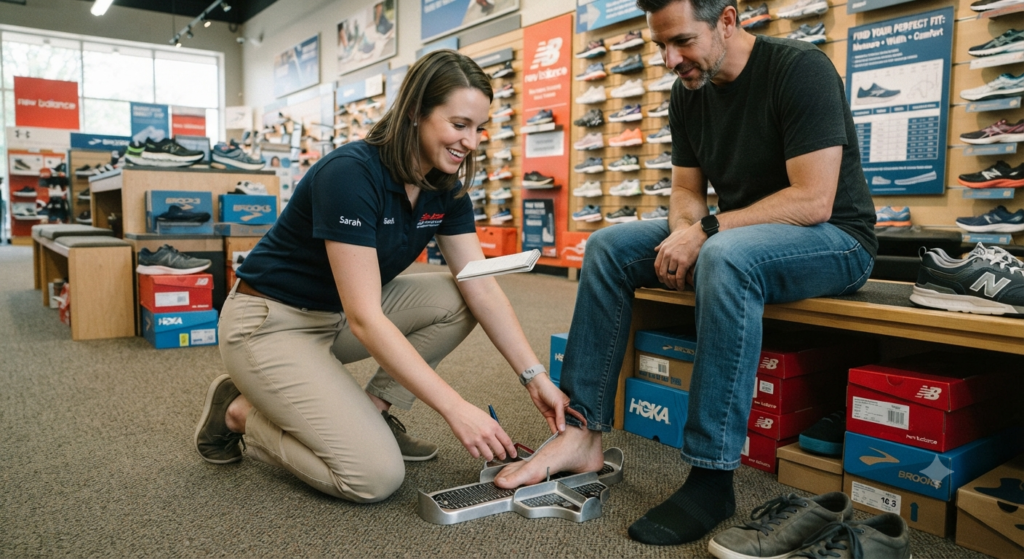
Finding the perfect shoe fit isn’t about memorizing a single number — it’s about understanding your feet, checking brand-specific charts, and paying attention to width, materials, and shoe type. A few extra minutes measuring your feet and reading a size chart can save you from blisters, returns, and wasted money down the road.
Take the time to measure your feet today, keep that measurement on hand, and refer to it every time you shop for new shoes. Your feet will thank you.


Post Comment